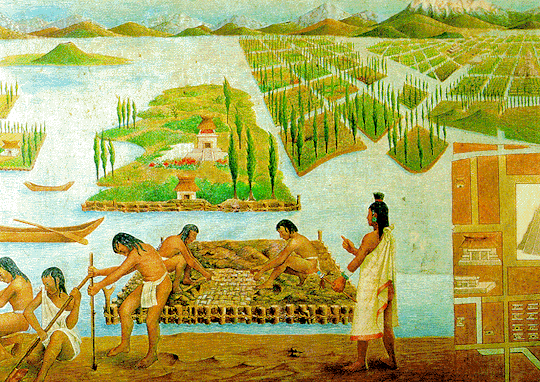
How on earth would you feed a city of over 200,000 people when the land around you was a swampy lake? Seems like an impossible task, but the Aztec managed it by creating floating gardens known as chinampas, then they farmed them intensively.
These ingenious creations were built up from the lake bed by piling layers of mud, decaying vegetation and reeds. This was a great way of recycling waste from the capital city Tenochtitlan. Each garden was framed and held together by wooden poles bound by reeds and then anchored to the lake floor with finely pruned willow trees. The Aztecs also dredged mud from the base of the canals which both kept the waterways clear and rejuvenate the nutrient levels in the gardens.
A variety of crops were grown, most commonly maize or corn, beans, chillies, squash, tomatoes, edible greens such as quelite and amaranth. Colourful flowers were also grown, essential produce for religious festivals and ceremonies. Each plot was systematically planned, the effective use of seedbeds allowed continuous planting and harvesting of crops.
Between each garden was a canal which enabled canoe transport. Fish and birds populated the water and were an additional source of food. [x]
This is literally so cool. Not only does it contribute to spacial efficiency, but the canals would easily keep pests, weeds, and possibly even diseases out of the respective plots. Companion planting and bio-intensive planting would be so much easier. Water-wise systems would be inherently present. Plus it looks so super neat aesthetically. I am just all about this.
Indigenous civilizations invented sustainable development way before there was a term for it.
This also means how to avoidrebooting a comic several times as well.As a former Reboot Queen, I thought I would post this for new webcomic creators or even ones who’ve been at it a while and are just feeling kind of uncertain about their work.
I actually posted this on a forum first, but thought someone here might also find it useful. XP Note that these are not unspoken rules or anything! First and foremost, do what you feel you need to! Everyone learns in their own way.
1: At the beginning, aim shorter. If you’re just getting into webcomics, try some experimental one-shots first. It’s the comics with no end in sight (or an ending waaayyy too out of sight) that are more likely to be left unfinished. If your projects involve characters or plotlines you REALLY want to use again, you can always leave them open-ended to continue them, or just move on to your grand, epic project after getting the hang of things a bit first. XP It’s just better to start out kind of slow and learn your strengths and weaknesses. Or even if you’re not new to comics, this is still a good way to experiment.
2: NEVER start a comic on a sudden inspiration. You want to make an art or some short comics when this happens, cool, but what seems great to you one month may seem kinda lame the next. I mean, sure, we all have moments where we’re not as interested in our comics, but if you pick subjects you truly love, it makes it easier to plow through those downer moments. XP Heck, this advice can go for ANY sort of project.
3: If possible, avoid rebooting old chapters because of amateur art/writing. If you absolutely need to for publishing reasons or to change some plot elements, then do what you must, but doing this can REALLY slow things down. That old art/writing may make your eyes bleed, but remember that most readers really don’t mind and even enjoy seeing an artist grow.
4: Even with a longer series, have an ending in sight. Again, kind of related to tip 1. Basically, unless you’re making a comic strip or slice of life or something, make it possible to reach the end of your comic in your lifetime! Consider trimming unnecessary bulk from your story.
5: Don’t let readers’ opinions sway you! I don’t mean ignore helpful constructive criticism, I mean people who question how a character acts, or say “I hope this doesn’t happen!” or anything that might be making you second guess parts of your story. I actually spazzed out and changed an entire character because people were considering her too ‘Mary Sue’, and a lot of the reboots I made were partially influenced by reader opinions as well! Make the story YOU want to make, don’t worry about your characters being cliched (heck, even if they are), or people having a different opinion of your characters than you expected. Stay the course! XP
Though also remember that it’s okay to have unfinished webcomics. They helped you learn and are still art, so they were worth the effort.^^
Save any picture you find that gives you that smallest idea, even if you won’t use it right away. It gives you a folder of things to look through when the urge to draw is there but the ideas arent.
From structure and plot to heroes and characters, your story must have everything in place if it’s to connect with the reader. Follow our guide to storytelling success.
There’s an eighth step most of these things tend to miss. It’s called practice. One would assume that such a step follows without needing a mention, but I think it’s important enough to deserve bringing to notice.




 Chimaeric Archive