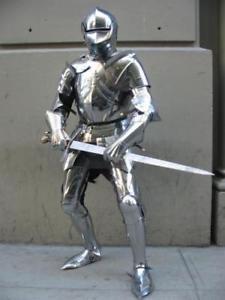
@earlgreyer1 I totally do! If we stay in keeping with the “logic” of typical game armor for women, I’m thinking it should provide equivalent protection to this:
It’s been faaaar too long since I did a “kitting up” photoset, so I thought I’d do another one of my heavy Chesterwick kit, which I wear for Swordcraft on Fridays when I’m not being an archer and wearing a dress. This kit puts me on maximum hitpoints (15) at Swordcraft and is all 100% functional stainless steel stuff I also use for other medieval activities – which means it’s not exactly light. It’s inspired by what a 14th century knight would wear, although I’ve taken a fair amount of creative liberty.
Here’s a breakdown of each layer, generously photographed by my friend @andrethesmall (and please ignore my funny faces, it’s been a long week):
1. Underwear! Medieval linen braies with an undertunic tucked into them. I’m also wearing workout pants underneath because it’s currently winter and I’m a lizard. In the summer I skip that layer. All of my medieval underwear is from Historic Enterprises. Unfortunately, they don’t really cater too much to women for this stuff (given that it is men’s clothing!), but I find I can fit most of it, although it’s not the most ideal fit, especially with the hose.
2. Hose! I love hose, I think they’re amazing and silly. I usually go for parti-coloured – I have three different colours to choose from (yellow, blue, green), so I just mix and match each week depending on what I feel like. I wear thick socks underneath to pad them out a little bit – since they’re made for men’s feet they’re a bit big on me.
3. Shoes, pourpoint, leg harness. The shoes are a new model from ArmStreet that I’m currently testing out for durability. They look medieval but have modern comfort, and feel great under armour! The pourpoint (tight vest) is what keeps up my leg harness (leg armour). Most of the weight of my leg harness is distributed across my hips, with very little actually pulling on my shoulders. If you look closely, you can see lots of vertical stitch marks in the pourpoint – that’s where I’ve taken it in time and time again as it’s really old and the linen keeps stetching! It’s really important for a pourpoint to be super tight to ensure an ideal distribution of weight. My leg harness is the same I’ve had for a few years now, from ArmStreet.
4. Gambeson! Mine is a bit beaten up and needs some new buckles. A gambeson is a padded layer that just adds a little bit of cushioning from armor.
5. Armour. I’m wearing bracers, elbow cops and 14th century inspired shoulders, all of which is fringed with green suede dagging. I opted not to wear my upper cannons tonight (which would completely cover my upper arms).
6. Cotte d’armes, a wool garment in the colours of my warband that hides my beaten up gambeson. It has yellow wool dagging on it to make it a bit fancier and set me apart from other members of the warband who wear a similar, unadorned item.
7. Breastplate. Enough said.
8. Hood, because it’s cold out and my helmet doesn’t currently have an aventail to cover my neck.
9. A helmet to top it all off. It has a faceplate but I opt not to wear it at Swordcraft since I usually need to be able to communicate with people and I find I have to yell waaaay too loud with it on.
10. A photo taken by Tony Delov at the game, with my current halberd.
Please let me know if you have any questions, happy to answer!
Knights with guns is a real historical thing and, well, if you want a serious answer it’s probably because actual Medieval war history is not well-known or well-represented in pop-culture.
That’s one of the reasons why I find real Medieval arms and armor so cool, especially when placed in a fantasy setting. It’s because most writers of fantasy settings are copying what the previous generations of writers described, and the previous generation was describing what they saw from the generation before them, and none of them were doing any research, resulting in a long line of distorted and warped representations of “Medieval” warfare. Because of this, when a writer or artist actually does the research, it improves the coolness factor not only because you know that more work was put into the piece of media you’re experiencing, but also because that historically accurate stuff you’re seeing is new. Since it’s rare to see historically accurate arms and armor in fiction, the historically accurate arms and armor make the work feel creative and original compared to its peers, even though technically it’s just copying something that really exists in a museum somewhere.
And knights with guns is a pretty extreme example of that. It’s one thing to have historically accurate 15th century armor in your fiction
but pop culture teaches us that the handheld gun is a very recent thing that, once invented, brought about the end of the knight in shining armor because bullets can pierce plate armor and that’s why U.S. Marines aren’t out there in 60-pound suits of steel, but history and technology arn’t ever that straightforward. People don’t immediately give some traditional thing up just because a new invention has made it useless(look at how many armies still marched slowly in formation during WWI despite the spread of machinegun and mortar technology), and even if people did immediately give up the old ways as soon as something new came along, plate armor sticking around despite the popularization of handheld gun technology is not even an example of that. If you want to put guns in your story, don’t think that it automatically removes plate armor because plate armor is now useless(hell, most writers keep every character in full plate armor even though they write swords cutting straight through it, effectively making it useless extra weight in the world of their story.).
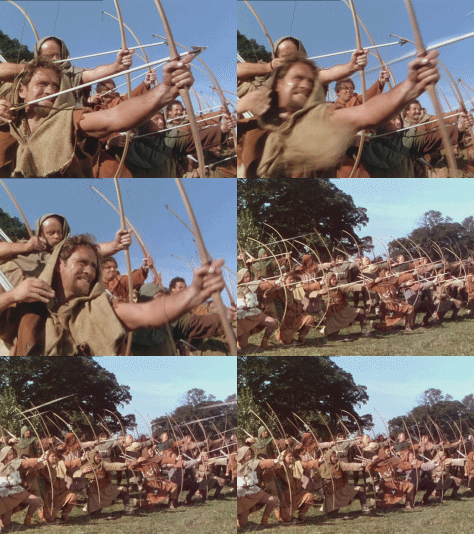
Plate armor doesn’t become useless just because a bullet can pierce it. If that were true, it would have been useless the same decade it was invented(the mid-14th century), because at that time, English longbow arrows and crossbow bolts were said to be piercing it too, or at least hitting with such force that it badly concussed the wearer inside the armor. But that hardly makes armor useless. Arrows, crossbow bolts, spears, etc. were piercing chainmaille before plate armor was invented and they still wore that.
Here is a metaphor:
Your objective is to cross a rainy parking lot without getting wet, and you have the option of taking or leaving your umbrella. Thinking that plate armor disappears as soon as guns are introduced to the setting is like saying that the umbrella is useless because it won’t protect you from a firehose. When you’re standing twenty feet from an English longbowman who has practiced so rigorously for twenty years that his left arm is visibly deformed, NOTHING can protect you,
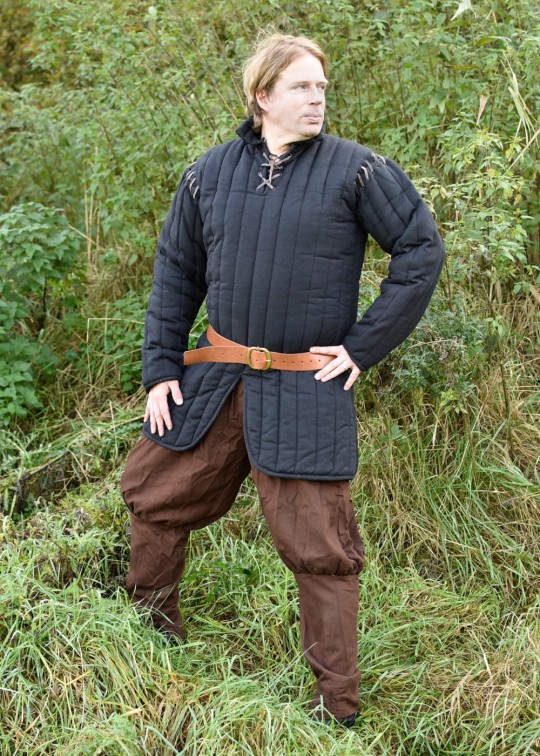
but when you’re two-hundred yards away being pelted by arrows falling from the sky at an angle, you want as much armor coverage as you can get, even if it wouldn’t protect you from a canon. Even just a really thick shirt is better than nothing in that case, because even that could block a few arrows, or at least stop them from going into your body as deep as they would otherwise.
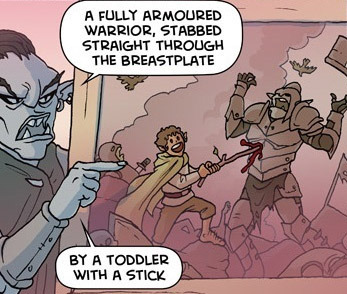
You can’t just cut through plate armor with a sword either. It’s too solid and swords are too light. That doesn’t mean an unarmored man can’t kill an armored man with a sword–he still can if he gets it threw the viewport or caves the helmet in with the butt of the sword–but it’s a hell of a lot harder for him to win than his opponent because the targets he has to hit on his opponent’s body are a lot smaller; and that’s what armor is all about: It will never make you completely invulnerable, but it makes your weak point a whole lot smaller than your opponent’s. For virtually any weapon, an unarmored man’s whole body is a weak point.
And even then, the evidence is in favor of the fact that plate armor wasn’t even just one of those things that stuck around because of tradition after guns became widespread. In fact, they were using handheld guns for as long as they were using plate armor.
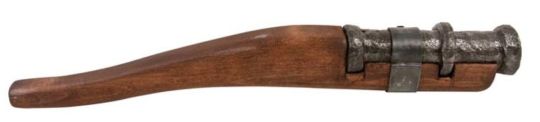
(A handheld gun from the 14th century.)
Until pretty recently in the lifespan of guns as a technology, plate armor could stop bullets. Guns didn’t bring an end to plate armor because they were just too powerful for it, it was because rulers realized that guns were just so much easier and cheaper to use than fully-armored knights. You could train someone to use a gun faster than you could train someone to use a bow, and for a whole lot less money. A wagonload of gold could buy you one fully-armored horseman, or one-thousand lightly-armored handgunners. Even though the knight could probably 1v1 all of them in a row, he can’t stand up to a whole army at one time(oversimplified but you get the point). Thus, heavy armor gradually gave-way to large formations of musketmen firing in volleys.
But that still means there was a several-century period of time were plate armor and guns were frequently found on the same battlefield.
In conclusion: Knights holding guns is cool not only because you’re combining two things together that are already cool on their own, but also because in real life knights used guns, yet you never see it in movies or video games because nobody does any research, so in the rare cases when you do see it it’s something new and fresh and original.
This is excellent, and fun, too.
Here are some extras for @sirobvious’s post:
This is an example of a knight with a gun (with armour that richly decorated, he’s a knight at the very least) from the Elizabethan period about 1588…
Here’s another from the Thirty Years War and English Civil War period, about 1640s, members of Sir Arthur Haselrig’s cuirassier regiment known as The Lobsters.
This fantasy art features vaguely late-medieval Gothic with a sallet and bevor, but to my eye rather modern-looking guns…
I reblogged it a couple
of years ago, and commented that an axe-head wasn’t a good “bayonet” since that assault-rifle
gun was all sorts of wrong shapes for an efficient axe-haft. Gun-axes (and gun-swords) did exist, but the firearm was an accessory to the blade; bayonets are an accessory to the firearm.
There were period weapons which would make better bayonets, such as the partizan (top)
and Ahlspiess:
The battle of Crecy (1346) was one of the most notable Hundred Years’
War victories won by use of the longbow (more so IMO than Agincourt) but it
also saw the one of the earliest uses of field artillery, which may have been
volley-guns called “ribauldequins”,
“crakys of warre” or “organ guns” rather like this repro.
…though they may also have been single-barrel guns like this…
Here’s the sort of “transitional” armour worn at
Crecy, though “knights on the same battlefield as guns” isn’t quite the same as “knights armed with guns”…
That multi-barrel
arrangement kept turning up in subsequent centuries, but always with the
same
drawback: it took (barrel number) times longer to reload than a
single-barrel gun. Obviously the gunners didn’t need to reload all of
them every time, but not doing so rather defeated the purpose of having
all
those barrels in the first place…
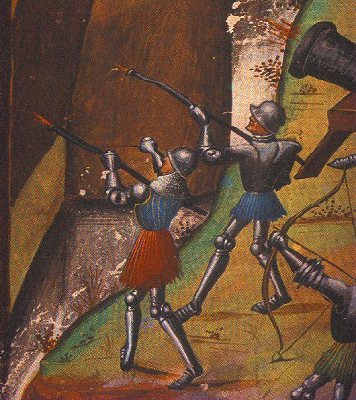
Here are a couple more period images of knights, or at least men-at-arms, using guns. The earliest is a “fire-pot” which shot enormous arrows, from about 1290 – that nervous-looking gunner’s all-mail armour with ailettes (the little shields at his shoulders) is from the late 1200s…
…while this is a “hand-culverin” or “hand-gonne” from about 1400…
It’s still not a convenient personal “gun” whether pistol or rifle,
more along the cumbersome lines of one-man light artillery. I found this page from Funcken’s “Age of Chivalry Vol.2″ which
has, among other things, a modern interpretation (9) as well
as a mounted knight with a hand-cannon.
It’s based on this engraving from about 1860-90…
…which most sources I’ve seen claim is based on an illustration from a treatise, “De
Machinis Libri Decem”
by Martinus Jacopus,
written about 1449 .
Unfortunately I’ve had no luck finding that original, but
the engraving is as close to being a historical picture of “knight armed with gun”
as I can think of.
A fantasy setting – once you take trouble to explain how it came to pass
– lets you reach a century or so beyond the baby cannons used
alongside High Medieval plate armour, or even the long saddle pistols of the 16th and 17th centuries.
Now you can include very early revolvers – this 9-shot Stopler wheellock
from 1597 Nuremberg is the oldest one known…
…though at least one article points out it’s too
well-made to be the first of its
kind. There were others before it…
There were also breech-loading wheellocks, called “chamber pieces” – once its cartridge was in place the gun was
primed and its spring wound in the usual way. Henry VIII of England had
at least one arquebus like this.
In fantasy you can also play with other repeating or multi-shot
mechanisms – the
“harmonica gun” has been used, but there’s also pepperbox, duck-foot, volley gun,
multi-lock, superimposed load, etc. etc. – which came and went, sometimes in a single
loud and very final explosion. Will
the fantasy multi-shot go Bang! – Bang! – Bang! as intended or, as often in real life, Boom! Can someone find my hand? when everything goes off at once.
Furthermore, in that fantasy setting you may well find wizards,
sorcerers and other bright-lights-loud-noises-and-death-from-a-distance
merchants who have something to say about non-magical weapons trespassing on
their specialty. They never strike me as the sort of people who would settle for just a
cease-and-desist letter…
Read “Men At Arms” by Terry Pratchett for one example of a firearm in a late-medieval / early Renaissance setting, before Discworld in general and Ankh-Morpork in particular settled on the late-Georgian / early Victorian feel that it maintained to the end.
The firearm in question (Terry confirmed it) is a
harmonica gun
like this one.
After trying to keep it a mystery in the text, Terry wasn’t pleased when the art by Josh Kirby for the UK first edition had a spoiler right there on the back cover…




 Chimaeric Archive