not to get mad nerdy but I just discovered tabletopaudio.com and I’m fuckin losing it
this person (people?) goes about making 10 minute long loopable ambient noise tracks for every imaginable setting (docks, taverns, forests, airships, spaceships, office buildings, sewers, EVERYTHING) and has over a hundred tracks to offer, and on top of that if none of them suit you there’s a huge feature called soundpad where you can mix and match from their set of hundreds of individual sound effects and music clips to make your own ambient background track
holy shit dudes
I did a little further reading on his about and the guy running this is just a dad with two kids who like playing tabletops with him and he had the composition and musical training to start making soundtracks for his games then decided to spread that to the world for absolutely free, he even welcomes you to use his tracks in your works (podcasts, videos etc) and is open to being hired for custom tracks
Everyday updates: https://www.instagram.com/vakon/ – In the Buried City, everyone will meet many dangers. One of them is a trap. They have two basic features: they are SWIFT and they are deadly. Traps in the Buried city is extremely diverse, but most inexperienced adventurers end up on the most primitive. In order to avoid this requires careful attention to detail, like cracks in the walls and exposed floor slabs. One of the best solutions is to hire an experienced thief — these guys are usually well versed in this kind of… obstacles.
Day 2: DIVIDED group
Everyday updates: https://www.instagram.com/vakon/ – During the journey through the streets of the Buried City, there can happen a lot of surprises. Monsters, traps, landslips… Often you must to act quickly and make unusual decisions, just to stay alive. But what exactly you should not do – is to split up your group. Even, if at some moment you think that it may be the best solution… this is not so. Many of the inhabitants of these ancient places with the help of cunning and spells will try to divide you… and you will become their easy prey. Even if you have got quarreled – first you must get out on the surface and then you can go on all four sides, but in any case, do not separate on the trails of the Buried City. It has led to the deaths of a countless number of heroes and villains. – inspired by Justin Sweet & Vance Kovacs
Day 3: The POISON of greed
Everyday updates: https://www.instagram.com/vakon/ – In the depths of the Buried City, you can stumble upon hundreds of deadly poisons. From intricate traps to poisoned fangs and claws of the ancient inhabitants of the depths. But one of the most terrible poisons that can be found is the poison of greed. It can kill you in many different ways – from undetected traps in the form of a treasure hunt to the dagger in the back from the satellites, which do not want to share with your newfound wealth. Remember, no matter what you can found in the depths if you not able to bear it out…
Whether you’re religious or not, there’s no denying the cultural, political, and social impact that religion has had on the world around us.
So when crafting a brand new world, whether it’s high fantasy, science fiction, science fantasy, etc., religion can play a big part of the world that you’re building. And because of its relative importance, there are a lot of things to think about re: crafted religions.
Religions Shape Morals and Virtues
Morals are a strange thing. People aren’t born with an innate knowledge of what to do in life, or how to act. It only makes sense, then, that people would turn to religion as a guide for how they should behave. That’s easy enough to see with the world we live in.
The Golden Rule. Nearly everybody learns this one growing up. For Christians, it comes in the form of a Biblical quote – “Do unto others as you would have them do unto you.” But the concept isn’t unique to Christianity. Nearly every religion has this same rule, in some form or another.
But when you get further into the details of differing religions, you see that each has its own set of morals and what it feels is “right.” This can range from Evangelicals who feel that same-sex love is a sin because of an archaic passage from the old testament to vegetarianism as a way to avoid hurting other living creatures, commonly found among Hindus.
So What Does This Mean?
Well, this means that when you’re crafting a religion, one of the things to think about is what morals you want in your world.
Don’t want a world with a bunch of homophobic assholes? I’ve got good news for you! A same-sex couple amongst your pantheon of Gods and you can have a world where people don’t just accept same-sex love, but celebrate it!
But that’s not the only thing to think about. Different taboos are often religion-centric as well.
These taboos can have minor consequences on your world-building in some ways. For example, maybe you just want to make things more interesting by adding details such as characters who avoid certain kinds of metals or stones because they’re strictly forbidden in their religious texts.
These taboos can also have major consequences on your story. For example, even in the modern day and age there are a lot of prejudices against albinism in some African countries. You can imagine the consequences for such a character.
Religions Shape Cultural Practices and Thoughts
In the West, pretty much everybody celebrates the holidays, even if they aren’t Christian. They may adapt their practices depending on their beliefs, but regardless, if you live in a country like America you’ll experience a lot of religious influence around the holiday season. Christmas, a day that celebrates the birth of a religious figure, has a tremendous cultural impact even on those that aren’t Christian.
When crafting a religion, it only makes sense to think about the cultural impact said religion will have. Holidays, prayer, rituals, religious pilgrimages, the way that people keep track of time (as in our AD system), taboos (as already mentioned), fasting, celibacy, religious bathing/cleansing…
These are just a few practices that exist within different religions. Many are so ingrained in our culture that people don’t even think of them as “religious” any more.
For example, the practice of abstaining from sex before marriage. This single religious belief has created a culture that is very prohibitive regarding sexuality. A lot of people still think that fewer sex partners = a better person, even those who aren’t adherents of any religious philosophy. It’s just something that’s ingrained in our culture.
All this to say – the best starting point for creating a religion in a fictional world is knowing what kind of world you want to write.
With all that out of the way, let’s get on to the actual creation process. There are a few things to think about, but I want to start with something I feel is very important.
There are a lot of religions out there. I suggest you research them and learn about them.
But please don’t just take an existing religion, especially one from another culture, slap a new name on it, give it an air of mysticism, and then be done with it. It’s disrespectful to those who actually practice these religions.
*Ahem* Okay, I’ve said my piece and now I’ll move on.
Remember – Multiple Religions Can and Usually Do Exist in a Culture
This is the first and most important thing I want to point out. Most of the stories I’ve seen where creators do religion right is when they remember that not everybody practices the same religion.
George R. R. Martin does this incredibly well with the different religions in ASOIAF. They are all different, they are all unique, they are very much shaped by the part of the world that those characters live in.
Also remember that the same religion can have many different interpretations, leading to different branches and sects. They can be quite different and they may not get along that well. This is another thing that is often forgotten.
Different Types of Religions
Throughout history there have been many different types of religions. Some have a single god. Some have an entire pantheon. Some see gods as people. Some see gods as animals. Some gods are both people and animals, depending on the story that’s being told. Some religions see gods as having no form. Some religions teach that god is the universe. Some say that there are no gods, but there is power in everything.
Let’s Talk Prophets and Stuff
Another thing to remember is that religions are often centered on a prophet, or a person’s teachings. While a god or pantheon of gods may be central to that religion, the prophet/guru/etc. is also very important. Jesus, Muhammed, the Buddha… just a few real world examples.
This is where I take the time to point out something important. Your religion doesn’t have to have a male prophet/teacher. A prophet can be a woman. Or nonbinary. There can be six prophets who worked together, all of different gender identities. In fact, this can be a really good way to get rid of gross stuff like sexism in your world’s culture, or just plain avoid stereotypical high fantasy with Manly Men and Damsels in Distress.
Leave Some Stuff Unexplained
Another thing I want to point out is that religions don’t usually have explanations for everything. I mean, the whole point of religion is faith most of the time.
I was talking with @more-legit-gr8er-writing-tips earlier about this. Because I still get mad about the midichlorian thing in Star Wars. The Force was an awesome (if a little underdeveloped) religion. It was focused on the power that exists in all things rather than the idea of a god. Certain people could access the Force. All was good. Then they made the Force the result of little critters that live inside people.
No. No no no. Okay, I’ll stop. Just suffice it to say, whatever genre you’re writing in, don’t feel the need to explain everything. Even if magic exists, even if there’s science, just embrace the mystery and the wonder of the religion you’ve created.
Religious Institutions
I’ll keep this one short. But just remember that where there’s religion, there’s inevitably going to be some sort of religious institution. It may be that in your world every town has its own religious leader and group of scholars. Or you could have a vast system of temples. Or you could have the fantasy equivalent of the Catholic Church.
(Remember also – the bigger a religious institution is, and the more influence it has on the people, the more likely it is going to be a power in its own right in your world – a.k.a. the Catholic Church basically being a governing power in our own history.)
Religion in Science Fiction
Apart from some science fantasy, I’m hard pressed to find many science fiction stories that include religion. I think there’s a general assumption that people will move away from religion, especially as we learn more about the world we live in.
But… people are people. And I’m 100% sure that there will always be some people who believe in something. Your dystopian government may not like it, but somebody somewhere will discover the last unburned copy of the Torah and a brand new religion with elements of Judaism will spring up around it.
And that starship flying through space in the year 3277? Probably going to have Buddhists, Hindus, Christians, Muslims, and who knows what else on board. Though they may not practice religion the same way we do now. And who the crap knows what the aliens are going to believe in.
Common Themes in Religion
One of the final things I have to say is that, for as many differences there are in religions, there are a lot of commonalities. Things like prophets, and trickster gods, and miraculous births (such as children being found in rivers or born to virgins). I suggest you do some research on the commonalities in religions and use them if you need a bit of inspiration for crafting your own.
Anyway, I’ve rambled long enough. I just want you to consider some of these things. This is just one way to build a little more complexity into a world you’ve created, and it can do a lot for everything from plot to making the reader really believe that your world exists. So have at it! Enjoy playing god(s).
I can hear you groaning back there. Hold on and hear me out.
When you’re creating a fantasy world or a sci-fi world, many things define cultures. One of the most important for a lot of writers is religion, with politics being secondary in a lot of cases.
But how often, when trying to create a unique world for your characters, do you stop and think about how money works for them? Or if they use money at all?
Let me pause right here and give you the dictionary definition of economics. That might help you understand exactly what I’m talking about –
ec·o·nom·icsˌ
ekəˈnämiks,ˌēkəˈnämiks/
noun
1.the branch of knowledge concerned with the production, consumption, and transfer of wealth.
It’s not just a “money” thing. Economics is all about how things move in a society – where things come from, who produces those things, and – most importantly for worldbuilding – how the people in a community are affected by that system.
A lot of writers will just look at our world and transfer that model directly into the world they’re writing about. There are rich people who have money, and poor people who don’t. In science fiction novels, people might exchange credits for the things they need. In fantasy, characters hand over gold coins without the writer giving it a second thought.
So What’s the Issue?
Well, the issue is this – different economic systems work (arguably) for different worlds. You can see that in our current society. Different countries function better with different economic landscapes. That’s been true through history, too, and economics have changed with the times.
But… I Don’t Know Anything About Economics
Nobody is asking you to write a giant manifesto about the next great economical system. Nor do you need to describe the details of your world’s economics in your story. Your characters likely don’t know everything about how their economics work, and your reader probably won’t care.
But. But. Little details here and there can help enhance a world and show how it’s different from ours. Little economic details can help you better understand how your world actually functions. They can better explain things about your characters and the lives they’ve lead up to that point.
Case in point. In the Dragon Age series of games, there is a magical substance known as lyrium, which is important to both mages and soldiers known as Templars (who use the substance to increase their power).
Because lyrium affects most individuals, but not dwarves in this world, dwarves have developed an entire society centered on mining and distributing lyrium to the other races. Dwarves are merchants primarily. There is also a large dwarven crime syndicate that smuggles lyrium illegally. In essence, the importance of lyrium has led to a lyrium-based economics system for the dwarves in this world.
So What Things Should I Be Thinking About?
The biggest thing to consider is what “wealth” means in the world you’ve created. First and foremost, where does most wealth come from?
Let’s look for a moment at our history. In one example,lLandowners with a lot of good, workable property became rich usually because of taxes. They took money from other (poorer) people in exchange for a place to live, as well as protection. Those landowners became the “lords” and “kings” of the places and peoples they swore their protection to in exchange for money, goods, and services.
This is the basis of most fantasy fiction. There are also many ways this system could be exploited in a fantasy world.
Here’s a hypothetical. In a high fantasy world, only a certain type of person is able to fight and kill demons that appeared a few centuries earlier. Most people would be dead if left to their own devices.
But, these Demon Fighters realized they could exploit their abilities. They offered to protect the common folk in exchange for what the people could provide them. So, in time, the Demon Fighters became the ruling class.
But even among the Demon Fighters there is a class system. Not every Demon Fighter has the same abilities. Some individuals are more suited to combat, being able to take down demons by force. Others have the ability to control demons. In time, the combat-able Demon Fighters become soldiers and those with the ability to control demons become Nobles, most of whom have demon servants and bodyguards.
Let’s Talk About Surplus and Scarcity
In most societies, economics are centered on two principles.
The first is surplus. Having a surplus means having more than is needed of something. The other is scarcity. You can guess what this is. The more scarce something is (i.e. the less of something there is) the more valuable it becomes.
The more food that is available, the less difficult it becomes to acquire food. It can be freely traded, whether for other items/services of equal value or for money (or whatever symbolic exchange product a society uses, like “credits” in a sci-fi world). If there’s not a lot of food to go around, it becomes more difficult to acquire food.
The person who has a lot of a needed thing holds power over those who don’t have that thing. In the Dragon Age example, even though dwarves aren’t human they aren’t treated as poorly as elves, another race that exists within that world. People rely on dwarves for lyrium, which gives them power, which means that even if they aren’t human they are important enough to humans to be treated more “equally” than elves.
Post-scarcity economies are often found in science fiction that idealizes the future. Often these societies have a lack of a power structure. If anybody can go out and get what they want or need at any given time, then it’s hard for any one group to hold sway over the rest.
Sometimes, companies today will create false scarcity by destroying goods and forcing the prices of those goods to be higher than it should be. This has happened in the dairy industry, with tons of milk being disposed of because dairy farmers want to protect their livelihood.
I will say that I am NOT an economics expert, by any means. Nor do you have to be to think about it when writing fiction.
Just be aware of the power structures that exist because of economics, and how this will likely play a role in the world you’ve built. Think of ways to play around with the power structures. Think of how your idea of space travel or demons or whatever will affect your world’s power structures.
All this can lead to a lot of interesting dynamics in your world that can help set it apart from the rest.
this is whats called a ‘coffer dam’, you basically build some walls, drop them in the water, tie them together, and then pump out the water from your new hole in the water so you can build while staying dry
its oddly not that hard- the flippin ROMANS were able to do it with logs and mud
occasionally particularly devious people would use this to hide treasure or tombs underneath the river so its not only impossible to find but impossible to get to without an engineer division
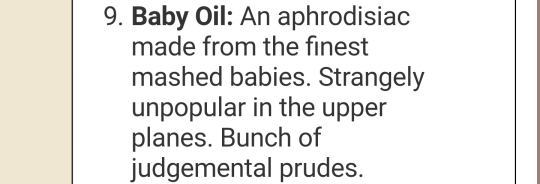
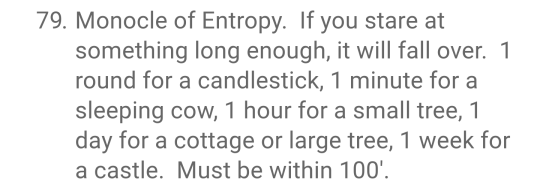
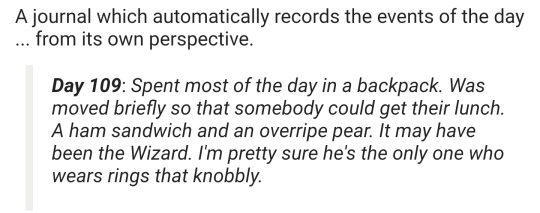
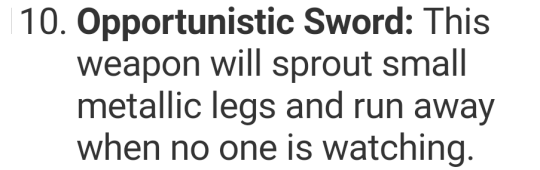
So I was having a lovely conversation with @princeofsparrows about magic and magical items and he sent me several links to very useful lists and tables. Those can be used by any DM to improve the game and set some more fun/challenge into the game without adding enemies or limiting themselves to always better armors and weapons.
My players usually discuss for an hour about the best way to open every door with a single rune on it (even if the rune actually just means “toilets”). So if I give them an omniously glowing fork and they will turn around it for half of the evening…
We decided to share with you some links with awesome ideas for loot (or your NPC merchants). The links below include (but are not limited to):
Belt of Pants: This belt creates illusory pants on the wearer. The wearer can suppress the illusion at will.
Digging Spoon: This tiny spoon can dig through any substance with a forceful push.
Hungry coin: Cursed. Will attempt to eat other coins that it comes into contact with. Eats 100 coins an hour.
Crossbow of Whispers (Weapon, light crossbow): You can use an action to whisper a message and fire a bolt from this weapon at a target within range. If you hit, the target (and only the target) hears the message.
Scroll of Cure Blindness: Cures blindness when read.
101 Silly/Useless Magic Items – You need to read through 7 pages of the thread but there are some very nice ideas!
1001 most useless (dungeons and dragons) magical items – There are actually 21 of them on this list but they are really useless. It could be nice to drop something like that on the players so they can have some fun…
Now I will let @princeofsparrows to continue. He still has some things to add 🙂
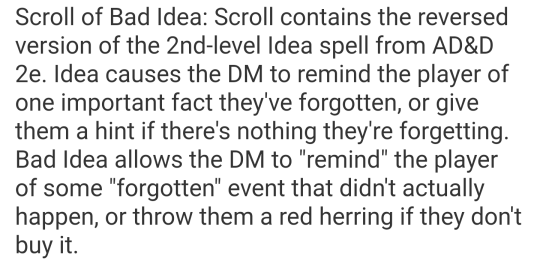
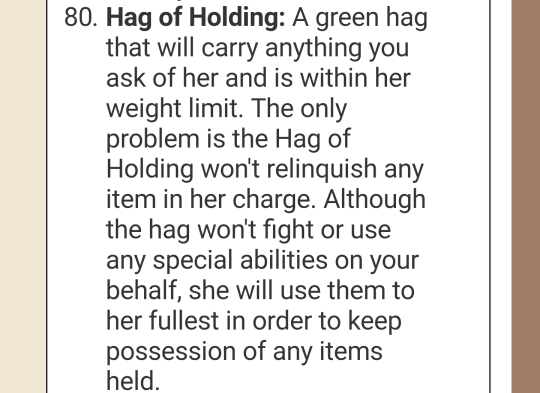
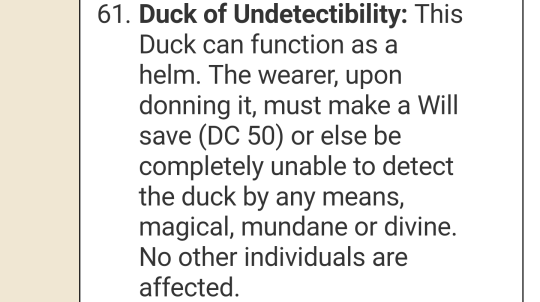
The great thing about a lot of these items is that, despite their apparent uselessness, as with most things in D&D, an innovative player can find some use for it… and I feel it throws a bit of a wrench into the mix. Here are some other honorable mentions:
Proposal: instead of creating fantasy names by inventively misspelling real names, create fantasy names by cutting real names in half and stapling them back together with mismatched counterparts. e.g.:
So if you’re a dm like me, you probably want to be relatively skilled in some typical fantasy accents for your game to make things feel that much more real. So i’ve decided to throw together a little master post of “how to” videos on some various accents. This is mostly for my own reference, but if you’d like to save this for yourself too, go right ahead. Feel free to add on to this, as well!




 Chimaeric Archive