@earlgreyer1 I totally do! If we stay in keeping with the “logic” of typical game armor for women, I’m thinking it should provide equivalent protection to this:
the full moons of the year have a variety of names and were originally used to track the seasons and year, often used by farmers for planting/harvesting reference. each full moon may have various different names, the names used are the most common ones currently.
🐺 WOLF MOON –
full moon of january. influences spells that strengthen and renew you, self care, prosperity and healing spells, as well as spirit work.
❄️️
SNOW MOON – full moon of february. influences family related magic, domestic magic, spells that benefit others, and psychic abilities
🐛
WORM MOON –
full moon of march. influences preparation, planning, and time-intensive rituals, prosperity and healing magic, and tech witchcraft
🌸
PINK MOON
– full moon of april. influences spells that encourage growth, green witchcraft, potential, new beginnings, and working on relationships.
💐
FLOWER MOON
– full moon of may. influences commitments, strengthend foundations, green/herbal witchcraft, spirituality and working with spirits.
🍓
STRAWBERRY MOON
– full moon of june. influences love spells, friendship spells, magic that instigates changes and introspection, and travel magic.
🌩️
THUNDER MOON
– full moon of july. influences grounding and cleansing, magic that works with higher powers, and storm/rain witchcraft.
🐟
STURGEON MOON
– full moon of august. influences magic that gives back to others, magic that deals with emotionality, sea, river, and water witchcraft.
🍎 HARVEST MOON
– full moon of september. influences
kitchen witchcraft
completion, harvesting collecting debts, some interpret to be cursing.
🏹 HUNTER’S MOON
– full moon of october. influences money, home, and protection spells, the search for guides and spirit work, astral traveling.
🐀 BEAVER MOON
– full moon of november. influences home and hearth, and preparation for the winter, cosmic/celestial witchcraft, astrology, revealings
❄️️
COLD MOON
– full moon of december. influences
protection spells, self care spells, renewal and prosperity spells, ending and casting curses.
🌛 BLUE MOON – happens usually 1-2 times a year. it is the second full moon in one month because the 12 full moons do not divide evenly over the year, the month it happens in changes. for magic that encourages wisdom, healing, logic, and studying,
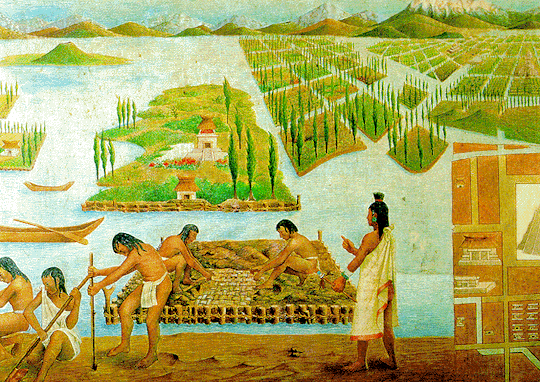
How on earth would you feed a city of over 200,000 people when the land around you was a swampy lake? Seems like an impossible task, but the Aztec managed it by creating floating gardens known as chinampas, then they farmed them intensively.
These ingenious creations were built up from the lake bed by piling layers of mud, decaying vegetation and reeds. This was a great way of recycling waste from the capital city Tenochtitlan. Each garden was framed and held together by wooden poles bound by reeds and then anchored to the lake floor with finely pruned willow trees. The Aztecs also dredged mud from the base of the canals which both kept the waterways clear and rejuvenate the nutrient levels in the gardens.
A variety of crops were grown, most commonly maize or corn, beans, chillies, squash, tomatoes, edible greens such as quelite and amaranth. Colourful flowers were also grown, essential produce for religious festivals and ceremonies. Each plot was systematically planned, the effective use of seedbeds allowed continuous planting and harvesting of crops.
Between each garden was a canal which enabled canoe transport. Fish and birds populated the water and were an additional source of food. [x]
This is literally so cool. Not only does it contribute to spacial efficiency, but the canals would easily keep pests, weeds, and possibly even diseases out of the respective plots. Companion planting and bio-intensive planting would be so much easier. Water-wise systems would be inherently present. Plus it looks so super neat aesthetically. I am just all about this.
Indigenous civilizations invented sustainable development way before there was a term for it.
So being tired of people constantly labeling every type of Indian dress as a “sari”, I figured I would make an informative post so that you all can educate yourselves. There are numerous variants of these, so I’m just presenting the basics.
(1) Sari
Basically a strip of unstitched cloth, ranging from four to nine meters in length, that is draped over the body in various styles. The sari is usually worn over a petticoat, and they’re known for their pleated fronts on the skirt portion. If your sari doesn’t have lovely pleats, you’re wearing it wrong. The blouses for saris can either cover or show the midriff. Dancing in a sari takes a lot of skill. This is a traditional dress so don’t be fooled into thinking they’re fancy wear—there are plenty of casual saris.
(2) Ghagra/Lehenga Choli
Traditionally worn in Rajasthan and Gujarat, as well as Punjab in folk dances and for weddings. It is a combination of lehenga, a tight choli and an odhani. A lehenga is a form of long skirt which is pleated. It is usually embroidered or has a thick border at the bottom. A choli is a blouse shell garment, which is cut to fit to the body and has short sleeves and a low neck. Blouses can either cover or show the midriff area. This is a very wonderful dress to wear for dancing. It’s Southern counterpart is the Langa Voni.
(3)Salwaar Kameez
Traditionally worn in Punjab, Haryana, and Himachel Pradesh, though now has become the most popular dress to wear. It’s referred to as a “suit” by many, and is similar to the suthar in Sindh and Kashmir. It consists of loose trousers (the salwar) narrow at the ankles, topped by a tunic top (the kameez). It is always worn with a dupatta which can be used to cover the head, otherwise draped over the shoulders. Most young women wear this in lieu of Western clothing on a casual basis.
(4) Churidaar Kurta
A variation of the salwaar kameez. A churidaar fits below the knees with horizontal gathers near the ankles. It’s usually worn with a long kurta or a kameez. This is considered more “fashionable” than the salwaar kameez, and can be casual or dressed up. They look amazing, but sometimes the tightness around the legs can be constraining—like skinny jeans.
(5) Pattu Pavadai/Reshme Langa
A traditional dress in south India and Rajasthan. It’s usually worn by small girls and teenagers.The pavada is a cone-shaped garment, usually of silk, that hangs down from the waist to the toes.
(6) Langa Voni
A type of South Indian dress mainly worn in Andhra Pradesh, Tamilnadu, Kerala, and Kamataka. It has two components—the langa is the cone shaped long flowing skirt that covers the body from the waist, reaching the feet. In some cases, it might be as long as knees or just lower than the knees too. The second part is the blouse, or a jacket, that covers the upper part of the woman’s body. It’s Northern counterpart is the Ghanga Choli.
(7)Mundum Neriyathum
The traditional wear of women in Kerala. It’s actually the oldest remnant of an ancient form of the sari, which only covered the lower half of the body. The most basic traditional piece is the mundu or lower garment while the neriyathu forms the upper garment of the mundu.It is the cultural costume of women in the Malayali community (often referred to as the kerala saree).
(8) Mekhela Sador
Traditional dress of Assamese women.There are three main pieces of cloth that are draped around the body. The mekhela which is the bottom portion and is in the form of a sarong folded into pleats to fit around the waist. The top portion is called a sador, which is a long length of cloth that has one portion tucked into the mekhela and the rest draped over the body. The third piece is the riha, which is worn under the sador.
Again, there are various styles and types to each of their dresses which vary region from region. Some styles are casual, while others are for more formal occasions or used as bridal gowns. These different styles of dress can be found in other South Asian nations as well, though may be called something slightly different. (Example: Salwaar kameez are very common throughout the region). Hope this was of some help!
[Explanations are a mix of things from Wikipedia
(to make my life easier) and my own comments]



 Chimaeric Archive