Thank you to the Patrons who voted for this Tutorial! If you would like some bases to use freely for exercising your new knowledge, you can download them HERE.
If you would like to check out my reference Pile that I used for this tutorial, check that out HERE!
Hope this helped somehow in your journey to drawing plump and fat and chub folks c:
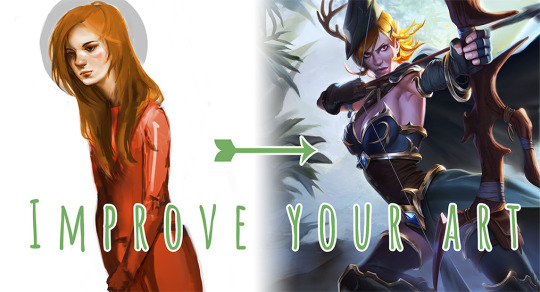
Have you ever felt like your art is on the same level for a long time? Have you ever felt like you can’t grow your skills. Have you ever felt like everyone around you grows in rapid speed and you are just like a snail at the end of the race?
I was thinking about that and trying to pinpoint the reasons why you might feel that way. I figured out some solutions that helped me and some other artists I know.
1. Not looking for critique/feedback
‘You can’t yourself pinpoint things you need to focus on because your eye still isn’t trained enough to pinpoint exact problems.’
This is number one problem I see and many professional artists will tell you about that. You can’t be too shy to show your work to people who can give you good critique. Look for professionals who are willing to help you and use that. Critiquing is mistaken to be something hurtful for young artists BUT in reality people giving feedback are trying to help you grow. I know how hard it is to hear that you are still not good enough, that your art is lacking something. Maybe you know that yourself but you can’t yourself pinpoint things you need to focus on because your eye still isn’t trained enough to pinpoint exact problems. The best person to go to would be professional with trained eyes who is able to say by flipping through your portfolio what it lacks and what you can do to make it look better. Don’t be afraid and seek that help. Don’t be too attached to your own art and accept that it isn’t perfect and you need a fresh pair of eyes to look at it.
2. Not implementing the feedback
‘Implementing is the key step in the process of growing.’
After you have done first step from my list and you finally found a professional willing to give you feedback try to implement feedback. Don’t just listen to it, nod few times pretending you understand what it being said. Don’t defend your art and don’t give excuses if the critique is genuine. Implementing is the key step in the process of growing. There is no use in feedback without you actually trying out the tips you were given. The whole point of that is to change your work. You are not being better artists by collecting thoughts about your art. Now it is time to do the work. It actually requires to put time and effort . Usually what people do,after receiving feedback, is they pat themselves on back like it was ‘job well done’ and being lazy. They are not willing to actually put in the work to implement feedback. It is time consuming and you need to put a lot of effort. Although without that there is not any point in seeking feedback.
3. Not trying/not failing enough
‘Embrace failures as a valuable lessons.’
Yes! There is lesson in failure! As hard as it is to understand. Once you collect experience you grow from it and become wiser. You know what path to choose to avoid next time failure. Successful people are the ones that can try something many times before they finally succeed. When they finally succeed it’s just a result of many attempts they have made before. No one is born ready for challenge. People are scared to lose because for our psyche it hurts more than a win feels good. People will try avoid at any cost losing so at some point they give up and stop trying. You can’t say for sure you will be successful artist after you did it for a year and don’t see result. You are not the one deciding how long it takes. It will be done some day. some day you will meet your artistic goals. But you will only meet them by trying and failing probably hundred times on a way. Just don’t be afraid. Those mistakes on a way are path that differentiate you and a professional. They already failed many times to get to where they are now. When you understand that you will embrace failures as a valuable lessons.
4. Doing things that are not challenging you.
‘Feel uncomfortable and pick up this damn pencil and draw like no one else is watching!’
Don’t settle in your comfort zone. You’ve heard that already many times right? That is why. You limit your skillset. Good things come out of comfort zone. If you feel like you have problems drawing something you are probably right. The reason is you don’t challenge yourself enough to draw things that are difficult for you. For example if you are only drawing a boy in front view standing with hands straight it doesn’t sound like the most exciting art right? But what if it’s the only thing you can draw and it looks somewhat decent? Well then, solution for that is easy – experiment with different angles, experiment with expressions, with composition, with different species. Be brave here and discover topics you don’t draw. You art will become more interesting and you will be more confident drawing. Personally I know that this is the hardest part for artists. It is hard to let go of what we know and discover unknown. We feel vulnerable and like we can’t really draw. This feeling sucks. As much as this feeling sucks you know what else sucks? Sucks that your skills are stagnating. Feel uncomfortable and pick up this damn pencil and draw like no one else is watching! I guarantee that after some time you will be surprised with what you created and how your art have changed.
Good luck to everyone who is on path of improvement!
I frequently see artists complain that their finished works got less attention than mere sketches, doodles and other smaller or less serious work. Which is frustrating! But almost as often, I can see exactly why the doodle got more attention. I’m going to cover some of these reasons, so you can use that information so you can do more than fume about it.
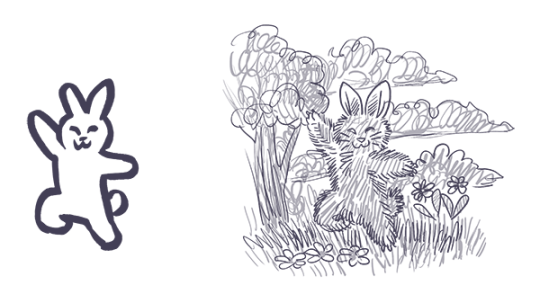
The doodle is easy to read, the polished work is busy
The polished work is completely drenched in little details that the artist slaved over, but the details create a kind of overall noise that makes everything harder to understand, making the whole image less appealing.
Don’t get too lost in little details, work from larger shapes to small details, use things like a highly readable silhouette, contrast, variance in line width or negative space to keep the image understandable. Pay attention to the composition to guide the eye where you want it.
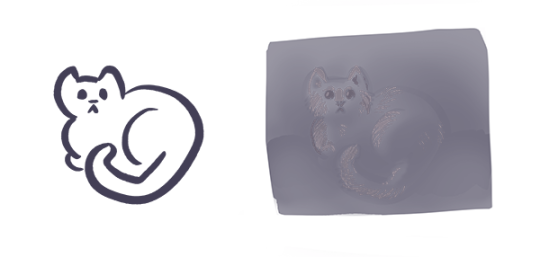
The doodle is high contrast, the polished work is low contrast
When you do lots of details all equally well lit and easy to see, overall you lose the strong lights and darks that make a work pop. You have to sacrifice some of those details, let them be in shadow or out of focus in the background, to create a more appealing image overall.
You might also be forgetting that without lineart you need to use strong lights and darks, since lineart creates it’s own natural high contrast.
Contrast draws the eye, use that to create focus where you want it.
The doodle is simple to understand, the polished work is highly ambiguous in meaning and message
Many doodles that outstrip the artist’s polished work are jokes. Jokes usually have a specific clear focus and message, the viewer can understand it immediately (if they couldn’t, it wouldn’t be funny). You don’t have to make everything funny, but like a joke, you need to get to the point and give the audience the information they need to “get it.” More details can be present, but the viewer should not be confused about what to look at from the outset. Remember: people will look at and interpret your art in milliseconds. They might give it a longer look but only AFTER that millisecond look.
The initial glance is like the first page of a book. If it wows them they keep looking to understand more, if they are lost and confused, no second chances, they’ve already scrolled away.
You can use things like composition, basic structures of shapes and simple shape symbolism to give viewers the initial information they need to stay interested. Don’t feel like you have to abandon more personal and difficult to parse symbolism, these things can work together to create intrigue.
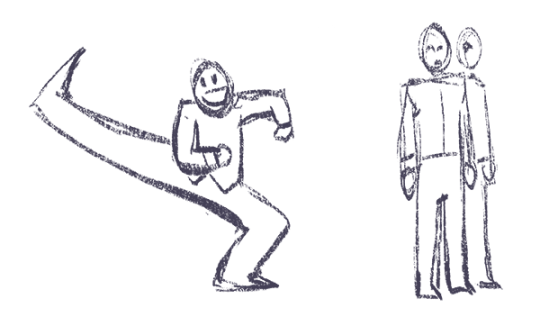
The doodle is fluid and expressive, the polished work is stiff and dead
The sketch for your polished work needs to be done with spontaneity and fluidity. When you want to really flex your drawing skills and show the world your beautiful realistic human faces, your sublime anatomy, gorgeous textures – it’s easy to forget about the undersketch and jump to rendering as soon as you can, creating a stiff or boring sketch that isn’t worthy of all the time you’re sinking into the minute details.
Practice quick gestures, read up on line of action, and before you make a polished painting, make sure you have a sketch that’s fun to look at even without the detailed rendering. Thumbnailing helps. Studies too. Sometimes you have to do the bad boring sketch, but you can take a few stabs at it.
You can’t make a bad sketch good by painting more details on it, you need to work out the sketch first before moving to the details.
Remember, if you’re going to spend 20 hours painting the thing, you can afford another half hour sketching a few different takes on your idea before digging in.
Lots of doodles, very few polished works
If you mostly post one kind of thing, your audience will be people who like that. Also, you may not have much practice with the techniques you are using in the polished work, while you have become a pro at doodles. You become an expert at what you practice, do more of what you want to be known for, become an expert at it, make it the only thing your audience is there for.
The audience is familiar with the subject of the doodle, unfamiliar with the subject of the polished work
Many artists do doodles of fanart and get fed up that people like that more, but the truth is, they don’t like it “more” they just already know they like it. You can increase the chances of people appreciating your original works by making sure they can understand what’s going on in the illustration without prior knowledge of who these characters are, or simply sticking to it until you have garnered an audience. Just keep at it.
Remember, the creators of the property you made fanart of are themselves artists who were pushing an original idea at one time. You can follow in their footsteps.
The doodle is quirky and unusual, the polished work is stale and samey
This can happen when an artist has an image in their head of what a SERIOUS and PROFESSIONAL painting looks like, usually based on a very narrow subset of artwork, often itself based on the same cargo cult of seriousness.
Try studying works outside your usual stomping grounds. Look to artists that likely inspired your faves (if you’re talking about realistic artists who inspired your favorite concept artists, here’s some likely culprits to get you started on the google search: JC Leyendecker, Alphonse Mucha, Norman Rockwell, James Gurney, Rembrandt), look to artists outside your genre, and look at your doodles and ask yourself what “not serious, just for fun” source of inspiration is making them so fresh and vibrant that your audience is connecting to them so strongly. Study that, respect that fun and try to pull it into your serious work.
The polished work was hard to make and no one cares
Being an artist is hard, and that we keep at it is commendable, but struggling and taking more hours doesn’t make a piece better necessarily.
There are a few things to consider here. First, you need to realize looking to the vague faceless masses of the internet for a fatherly “I’m proud of you, son” moment is always going to be disappointing and painful and attempting to guilt strangers into fulfilling that role for you is awkward and inappropriate. You need artist friends who can recognize your hard work and cheer you on and you need to be your own cheerleader, value your own hard work and practice.
Second, you need to realize torturing yourself doesn’t in and of itself make art better. Hard work is something people love about art, the meaning of someone spending that time, but if I screamed for 8 hours, drew a single line, then posted that, the internet wouldn’t be wrong to be unexcited about it. Rather than blame the viewer, think about two things: how can you make the art itself more appealing while still doing the painting that you’re interested in doing, and how can you do that faster and with less pointless suffering?
It’s okay to be a masochist when it comes to art, many artists are, just make sure you’re spending your time and suffering wisely.
You’re complaining about someone else’s “doodle”
Sketches and cartoons are deceptively hard to make appealing, rather than fume that they are getting more attention, look to them for lessons. What could you learn from them? Could you do it? Maybe you should try. Would make a good exercise.
And never get mad that their drawings are more appealing to the internet than yours, even though they spent less time on their drawing than you did on yours. See above for why time is not important here, but also keep in mind they may have been practicing longer than you or may be more established than you.
Keep working on your art, keep posting, push to be seen, advertise your work, put yourself out there. These things take time but work.
Why do my interests in canning, couponing, and homesteading overlap so often with blogs with titles like ‘The Obedient Housewife’?
Like, I’m like, “I want to learn to make soap and farm,” and suddenly I see 500 “traditional family” motherfuckers like no you are mistaken. I am just a simple lesbian anticapitalist looking to limit my consumerism as much as possible.
‘these fun crafts will keep your kids occupied until your husband gets home!’ no i want a clothespin crown for me
As a nerd who homesteads, let me share the data I have gathered!
First is my megalist of homesteading-related links I’ve gathered over the years. I’m a mod over at r/homesteading and this is where I’ve put a lot of good sources (not all, admittedly some are still sitting in my bookmark folder waiting to be added). The search function at reddit is wretched, but there’s also been lots of good things I’ve shared there too. Please note that many of these sources are not actual webpages, but PDFs. That’s not an accident, PDFs are where you find the really good in-depth stuff.
Many of my sources are from the Extension Service. They won’t try to relate to you based on your lifestyle or sexual identity or religion or whatever, but due to that, they also won’t be alienating you either.
The Cooperative Extension Service (US only) exists in all 50 states and in most counties. It is taxpayer funded. The Extension Service exists to help people become more self sufficient, for farmers to be more successful, for people to be healthier, for kids to be well adjusted, to figure out how to grow the best plants in your area, etc. Some county offices even offer cheap classes in things like gardening, canning, soap making, and they’re taught by people with training in these areas (I once heard a great talk on composting from a soil scientist that way). Do you want to know what type of plant something is? Do you need help figuring out a plant disease or pest issue? You can now contact them online and get great info.
I HIGHLY recommend checking out your state’s extension service website, because they do offer different types of information, depending on what is grown/raised where you are (and how well funded they are). My county extension puts out a monthly gardening newsletter, which includes a helpful ‘this is the time of the year to do —-’ part.
Here’s an example from New York – they have a calendar at the bottom, showing how they have things like hydroponic and urban agriculture workshops coming up.
Interested in raising animals? Penn State Extension is really really good. They have tons of free materials and courses available online, some I pulled for my megalist at the top of this.
National Center for Home Food Preservation – they cover the important aspects of food safety, and also have some recipes. Many state Extension Service websites will have lots more recipes.
If you have kids, check out4-H programs for them. It’s part of the local public school system here. If you’re homeschooling, you can also purchase their science-filled educational and self sufficiency materials (materials are divided by age ranges – Cloverbud Member: ages 5-8, Junior Member: ages 9-13, Senior Member: ages 14-19). One of my coworkers is in 4-H, she’s still in high school, and last year she raised an award-winning heifer.
Congress grants the money for funding these programs, and they’re connected with various universities. There’s a level of cutting edge scientific knowledge and academic rigor you don’t find in blogs or even most books. There’s LOTS of homesteading books filled with outdated information like ‘till the earth every year’ hell I still have older coworkers who do it and I’m trying to figure out how to gently tell them that they’re destroying their soil that way, and that there’s better methods now, methods grounded in science.
A compilation of stuff I know about drawing Asian faces and Asian culture! I feel like many “How-To-Draw” tutorials often default to European faces and are not really helpful when drawing people of other races. So I thought I’d put this together in case anyone is interested! Feel free to share this guide and shoot me questions if you have any! I’m by no means an expert, I just know a few things from drawing experience and from my own cultural background.
So if you’re a dm like me, you probably want to be relatively skilled in some typical fantasy accents for your game to make things feel that much more real. So i’ve decided to throw together a little master post of “how to” videos on some various accents. This is mostly for my own reference, but if you’d like to save this for yourself too, go right ahead. Feel free to add on to this, as well!
reblogging here because i can see this being relevant to anyone who’s ever tried to get out of an abusive relationship
Reblogging because that last comment made me reread the whole thing in a new light and realize this could be vital information. So, putting it out there for everyone, and hoping no one ever really needs it.


 Chimaeric Archive